
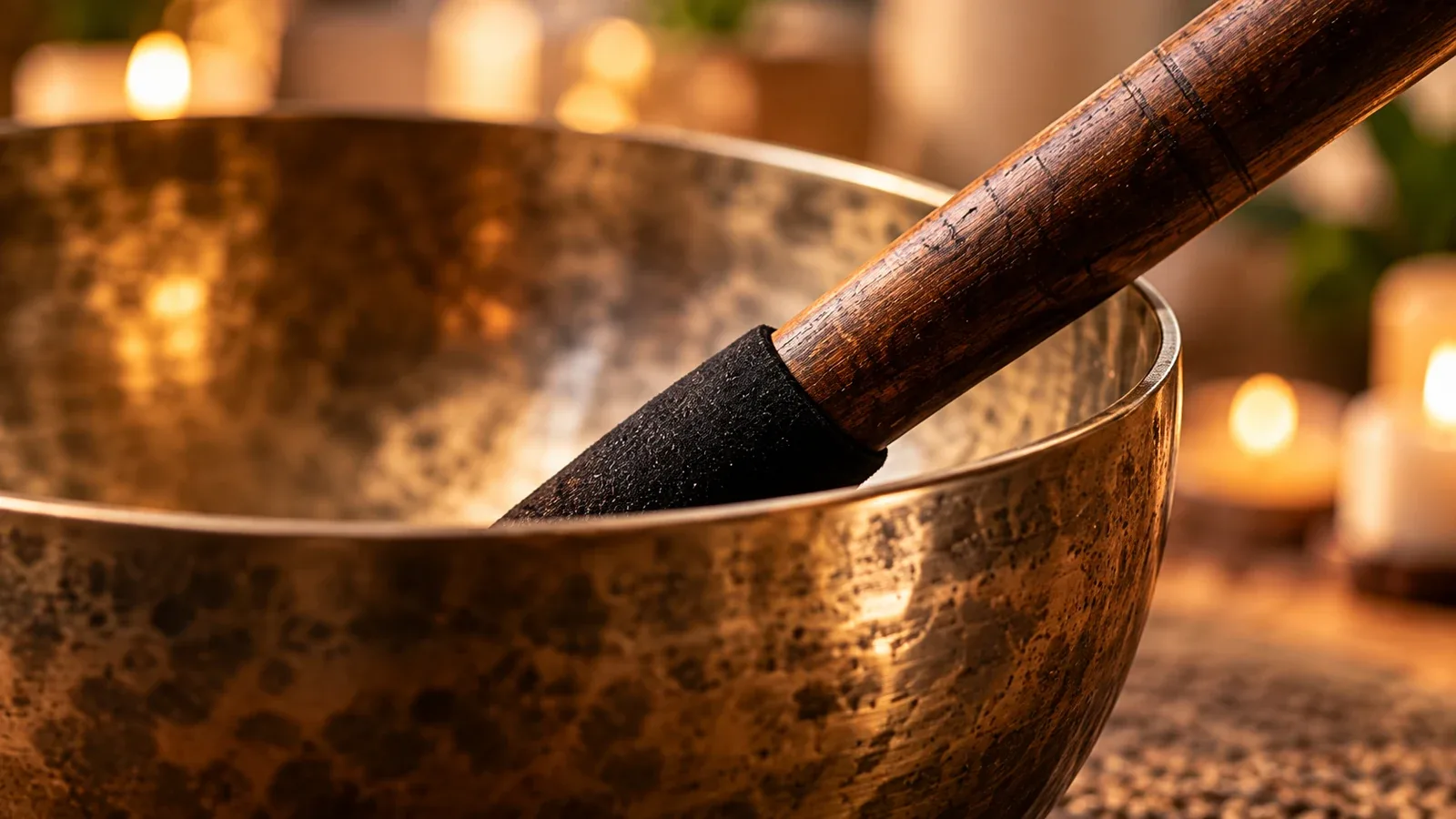
A sound bath is a group relaxation session in which you lie down, close your eyes, and listen while someone plays long, resonant instruments — singing bowls, gongs, chimes, sometimes voice — for about an hour. There's no water, and nothing is asked of you. You don't chant, move, or have to "do" meditation correctly. You listen, and the sound gives your attention somewhere to rest.
That simplicity is most of the appeal. For people who have tried sitting meditation and found it a fight with their own mind, a sound bath can feel like meditation with the difficulty turned down. It has also become one of the most common wellness events in the country: on a single day in late September 2026, SoundBath.co listed 1,105 upcoming sound baths across 94 cities and regions, from yoga studios and churches to parks, planetariums and living rooms.
This guide covers what actually happens at one, the instruments you'll hear, what the research says (and what it doesn't), safety, cost, and how to pick a session that suits you. If you're going to your first one soon, our shorter piece on what to expect at your first sound bath covers the practical side in more detail.
What a sound bath is — and isn't
The "bath" is a metaphor: you're immersed in sound the way you'd be immersed in water. Most sessions follow the same basic shape. Participants lie on mats, usually with blankets and pillows. The facilitator gives a short introduction, sometimes a few minutes of guided breathing or a body scan, and then plays for 45 to 75 minutes with little or no talking. The session ends with a gradual return to quiet and a few minutes to come back before anyone gets up.
A sound bath is not a concert. There's no melody to follow, no performance to watch, and most people keep their eyes closed the whole time. It's also not a medical treatment. Facilitators who describe their work honestly will talk about relaxation, rest, attention and experience rather than cures.
You'll see several related names on event listings, and they overlap:
Sound bath is the umbrella term for a lying-down group listening session with resonant instruments.
Gong bath is a sound bath centered on one or more large gongs. It tends to be fuller and louder, with bigger waves of sound. See our gong bath guide.
Sound meditation usually means a session with more guidance — a teacher talks you through where to put your attention, with sound as the anchor.
Sound healing is used both for group sessions and for one-on-one work, sometimes with bowls placed on or near the body. The word "healing" is doing a lot of work there; more on that below.
Sound journey is a marketing name for the same thing, often with a wider range of instruments or a narrative arc.
Many listings also pair sound with another practice — yoga nidra, restorative or yin yoga, breathwork, reiki or a cacao ceremony. In those, the sound usually comes at the end, as the resting part.
What happens at a typical session
Arrival. You check in, take off your shoes, and pick a spot. Most studios provide mats and blankets; many ask you to bring your own. Arriving 10 to 15 minutes early is standard, both to settle in and because latecomers entering a quiet room are the one thing everyone notices.
Setup. People make nests. A mat, a pillow under the head, a bolster or rolled blanket under the knees (which takes strain off the lower back), a blanket on top because you cool down when you lie still, and often an eye mask. Get comfortable before it starts; shifting around later is fine, but it's easier to settle once.
Introduction. The facilitator explains how the session works, may ask whether anyone is pregnant or has anything they should know about, and usually says something like: there's no right way to do this, it's fine to fall asleep, and if you need to move or leave, do.
The sound. Then it starts. Often softly — a single bowl, a chime — building into layers of overlapping tones that sustain and fade. Some facilitators walk around the room; others stay at a table of instruments. Volume rises and falls. With gongs there may be stretches that are genuinely loud and washing, followed by near silence.
The return. The sound thins out, and there's quiet. You'll be invited to wiggle your fingers and toes, roll to one side, and sit up slowly. Some groups share a word or two; most people just pack up quietly.
A typical listing runs 60 to 90 minutes including arrival and closing. Across the listings on SoundBath.co in late September 2026, 60, 75 and 90 minutes were the most common lengths, and about 95 upcoming sessions were outdoors — in parks, gardens and on beaches.
The instruments
You don't need to know what anything is called to enjoy a sound bath, but it helps to know what you're hearing.
Metal singing bowls. Hand-hammered or machine-made bowls of bronze alloy, played by striking them with a padded mallet or running a wooden stick around the rim so they "sing." They produce a complex tone with lots of overtones and a slightly wavering quality, because two close frequencies beat against each other.
Crystal singing bowls. Frosted or clear bowls made from quartz, in fixed sizes, usually tuned to specific notes. They're purer and louder than metal bowls, with a sustained, almost electronic tone. Many sound baths use a set of them tuned to a scale.
Gongs. Large, flat or slightly curved metal discs, usually suspended on a stand. A gong can go from a faint shimmer to a roar, and its sound has so many overtones that it's hard to hear a single pitch. Planetary gongs, tuned to frequencies derived from planetary orbits, are common; there's no evidence that the tuning scheme matters to your body, but they sound good.
Chimes, bells and tingshas. Small, bright sounds used to mark transitions or add sparkle on top of the bowls.
Drums, rain sticks and ocean drums. Textural and rhythmic sounds. A slow, steady drum is sometimes used at the start or end.
Tuning forks. Occasionally held near the ears or placed on the body in one-on-one sessions.
Voice. Humming, toning, overtone singing, or a simple song. Some sessions invite participants to hum along; most don't.
Monochords, shruti boxes, harmoniums and handpans. Drone and melodic instruments that add a steady bed of sound. A body monochord — a long wooden box with strings, sometimes placed under or beside a person — shows up in some clinical research.
What does a sound bath feel like?
People describe very different experiences, and the same person can have a different one each time. Common ones:
Deep relaxation. Heavy limbs, slow breathing, a sense of time going strange.
Drifting. A half-asleep state with dreamlike images or memories surfacing. This is normal; facilitators call it hypnagogic, the same state you pass through while falling asleep.
Sleep. Plenty of people doze off, and some snore. It isn't a failure. Most facilitators take it as a sign the room is doing its job.
Emotion. Some people cry, often without knowing why. Letting yourself rest is sometimes the first time in a while that feelings have room to come up.
Physical sensation. Vibration felt in the chest or belly, especially near gongs and large bowls. Tingling. Occasionally discomfort, which is worth noting and moving away from if needed.
Restlessness or boredom. Also normal, particularly the first time. Many people find the second session easier than the first.
What a sound bath shouldn't feel like is unsafe. If the sound becomes painfully loud, if you feel overwhelmed, or if something feels wrong, you can put in earplugs, cover your ears, sit up, or step out. A good facilitator will have said so at the start.
What the research says
This is the part of the sound bath world with the most exaggeration, so it's worth being precise. Claims about sound baths come from three different places, and they deserve different levels of trust:
Research — studies that measured something.
Tradition — ideas about sound and the body that come from spiritual or cultural systems.
Experience — what people report feeling, which is real but isn't the same as evidence of a mechanism.
On the research side, the honest summary is: the early evidence is encouraging for relaxation and mood, the studies are small and mostly weak, and nothing yet shows that sound baths treat any disease.
The most cited study is from 2017. Researchers at UC San Diego measured mood before and after a 60-minute singing bowl meditation in 62 adults. Afterward, participants reported significantly less tension, anger, fatigue and depressed mood, and greater spiritual well-being. People who had never done a sound meditation before showed a significantly greater drop in tension than experienced participants. The important caveat, which the authors state themselves: it was an observational study with no control group. It shows people felt better after the session; it can't show the bowls were the reason, rather than lying down quietly for an hour in a calm room.
The best overview so far is a 2025 systematic review in Integrative Medicine Research that pulled together 19 clinical studies of singing bowls, from randomized trials to case series. The authors concluded that singing bowl therapy "appears to be a safe and potentially beneficial intervention" — it may help with anxiety, depression and sleep quality — while rating the overall risk of bias in every randomized trial they assessed as high. Translation: promising, not proven.
Music and sleep is on firmer ground, and relevant because many people use sound baths for rest. A 2022 Cochrane review of 13 studies with 1,007 people with insomnia found moderate-certainty evidence that listening to music improved sleep quality, with no adverse effects reported. That's music generally, not sound baths specifically, but slow, sustained sound is the common ingredient.
Frequency claims are where the evidence is thinnest. You'll see "432 Hz" or "528 Hz" on many listings. A small 2019 double-blind pilot study of 33 healthy adults found that music tuned to 432 Hz lowered average heart rate slightly more than the same music tuned to 440 Hz. A 2025 randomized cross-over trial in 43 cancer patients found both 432 Hz and 443 Hz monochord sessions improved well-being and fatigue, with 432 Hz producing somewhat larger changes in heart rate and a few cardiovascular measures. These are interesting, small, early findings. They don't support claims that particular frequencies repair DNA, open chakras or "heal" anything.
Why it might work. There are plausible, unexotic explanations for why people feel better after a sound bath: lying still and warm for an hour; slow, predictable sound that doesn't demand attention; a break from screens and decisions; a room full of people doing the same thing; and the permission, explicitly given, to do nothing. Sound also gives a wandering mind a simple anchor, which is the core of many meditation techniques. None of this requires special frequencies — which may be why sound baths with very different instruments get similar reports.
For how sound baths fit into the broader conversation about calming the body's stress response, see our piece on nervous system regulation.
"Vibrational healing," chakras and other claims
Many facilitators draw on traditions that describe the body in terms of energy, vibration or chakras. Those frameworks can be meaningful as a way to guide attention and give a session shape — in the same way a yoga class might use imagery. They are not physiology, and they haven't been demonstrated in research.
A useful rule of thumb when you're reading an event description: language about relaxation, rest, presence, calm, and "a chance to slow down" describes what sound baths reliably offer. Language that promises to cure anxiety, detox cells, repair DNA, or treat a medical condition is overclaiming. It doesn't necessarily mean the facilitator is bad at what they do — plenty of skilled players use the vocabulary they were trained in — but it's not a reason to trust them more.
Where singing bowls come from
The story told at many sound baths is that singing bowls are an ancient Tibetan healing tool. The history is murkier. Metal bowls and standing bells have been used for centuries across Asia — the standing bells in Japanese Buddhist temples are one example — but scholars of Tibetan ritual music haven't found singing bowls among the instruments documented in Tibetan practice. As the writer Samuel Grimes set out in Tricycle in 2020, the "Tibetan singing bowl" as a meditation and sound healing instrument first appears in the written record in 1972, with an album by two American musicians, and its popularity grew in the West from there.
That doesn't make the bowls less beautiful or less useful. It's a reason to be skeptical of sessions sold on claims of ancient secret knowledge, and a reason to appreciate the modern sound bath for what it is: a relatively new practice that borrows instruments and ideas from many places.
Gongs have a long, well-documented history across East and Southeast Asia, in ritual, court music and signaling. Their use as a lying-down relaxation experience is, again, largely modern.
Is a sound bath safe?
For most people, yes. It's lying down and listening. A few things are worth knowing.
Volume. Gongs and large crystal bowls can get loud, especially up close. According to the National Institute on Deafness and Other Communication Disorders, long or repeated exposure to sounds at or above 85 decibels can cause hearing loss, while sounds at or below 70 decibels are unlikely to. A well-run sound bath shouldn't sit at painful levels, but if you're sensitive to sound, set up away from the instruments and bring earplugs — foam earplugs soften the sound without ruining it.
Pregnancy. Many facilitators ask pregnant participants to let them know, set up farther from gongs, and lie on their side rather than flat on their back. Research on sound baths in pregnancy is essentially nonexistent, so this is caution rather than evidence. Check with your own doctor or midwife if you're unsure.
Medical devices, seizures and other conditions. Some facilitators ask about pacemakers, implants, epilepsy or recent surgery, especially for sessions that put instruments on the body. There's little evidence of harm from group sessions, but telling the facilitator lets them adjust.
Emotional intensity. Deep relaxation can bring up feelings, and for people with trauma, lying still in the dark with strangers can be uncomfortable. Choosing a smaller group, keeping your eyes open, setting up near the door, or picking a session led by someone who describes their work as trauma-informed can all help. A sound bath is not a substitute for therapy or care for mental health conditions.
Touch. Some sessions include hands-on elements — bowls placed on the body, reiki, or adjustments. A good facilitator asks before touching anyone, and it's always fine to say no.
How much a sound bath costs
Prices vary with city, venue and group size, but most group sound baths are affordable. Of the 332 upcoming sound baths on SoundBath.co that listed a price in late September 2026, the median was $29, and the middle half cost between $20 and $36. About 9% were free — often in libraries, parks, community centers and churches. Sliding-scale pricing, where you pay what you can within a range, is common.
Private sessions, workshops that combine sound with other practices, and multi-hour events like full-moon ceremonies or overnight "sound sleeps" cost more. Online sound baths are often cheaper or donation-based.
How to choose a sound bath
A few questions make it easier to find one that suits you.
What kind of sound? Crystal bowls are clear and steady. Metal bowls are warmer and more textured. Gongs are bigger and more intense — some people love them, others find them too much for a first time. Listings usually say which instruments are used.
How much talking? Some sessions are nearly all sound; others include guided meditation, intention-setting, breathwork or yoga. If you want to simply rest, look for "sound bath" or "sound meditation" rather than "ceremony" or "workshop."
How big is the group? A dozen people in a small studio feels different from a hundred in a hall. Smaller groups are quieter and more personal; big events have their own energy.
Where? A studio with mats and blankets provided is easiest. Outdoor sessions are lovely and unpredictable. Churches and other resonant rooms can make the sound enormous.
Who's leading it? There is no licensing for sound bath facilitators, and training varies widely. Good signs: clear information about the session, honest language about benefits, an introduction that tells you you're free to move or leave, and attention to comfort and volume.
Can you get there relaxed? It sounds trivial, but a session twenty minutes away beats a better one across town if the drive leaves you rushed and stressed.
You can browse sessions near you by city on the cities page, or start with the sound bath guide and filter by date, price and time of day.
Sound baths online and at home
Online sound baths — live over video or recorded — are a real option, particularly if you can't get to a studio or want to try the experience before going in person. The sound is thinner through laptop speakers, so headphones or a decent speaker help a lot. Lie down, dim the lights, silence your phone, and treat it as a session rather than background noise. SoundBath.co lists online sessions alongside in-person ones.
At home, you don't need a set of bowls. A long, slow recording, headphones, a blanket and twenty minutes lying on the floor gets you surprisingly far.
Frequently asked questions
Do I need any experience? No. Sound baths are among the most beginner-friendly wellness events there are. You lie down and listen.
What should I wear? Comfortable, warm clothing you can lie down in. Layers are useful, and thick socks are a good idea since shoes usually come off.
Is it okay to fall asleep? Yes. Almost every facilitator says so, and many people do.
How often should I go? There's no prescribed dose. Some people go weekly as part of their routine; others go when they need a reset.
Can a sound bath help with anxiety or insomnia? Early research suggests sound meditation can reduce tension and improve mood in the short term, and music listening has good evidence for improving sleep quality. That's a reason to try it, not a treatment plan. If anxiety or insomnia is affecting your life, it's worth talking to a clinician as well.
Are sound baths religious? Most aren't. Some incorporate spiritual elements — intentions, chakras, moon phases, mantras — and listings usually make that clear.
What if I don't like it? That's useful information. Try a different kind — a gong bath if bowls felt too thin, bowls if gongs were too much, a guided sound meditation if unstructured quiet felt aimless — or accept that it isn't your thing. Plenty of people prefer breathwork, yoga nidra or plain meditation.
Sources
Goldsby, T.L., et al. (2017). Effects of singing bowl sound meditation on mood, tension, and well-being: an observational study. Journal of Evidence-Based Complementary & Alternative Medicine, 22(3).
Cai, Y., et al. (2025). Therapeutic effects of singing bowls: a systematic review of clinical studies. Integrative Medicine Research.
Jespersen, K.V., et al. (2022). Listening to music for insomnia in adults. Cochrane Database of Systematic Reviews.
Calamassi, D., & Pomponi, G.P. (2019). Music tuned to 440 Hz versus 432 Hz and the health effects: a double-blind cross-over pilot study. Explore, 15(4).
Hohneck, A., et al. (2025). Differential effects of sound interventions tuned to 432 Hz or 443 Hz on cardiovascular parameters in cancer patients: a randomized cross-over trial. BMC Complementary Medicine and Therapies.
Grimes, S.M. (2020). Tibetan singing bowls: where did they really come from? Tricycle.
National Institute on Deafness and Other Communication Disorders. Noise-induced hearing loss.
SoundBath.co listings data, counted September 26, 2026.