
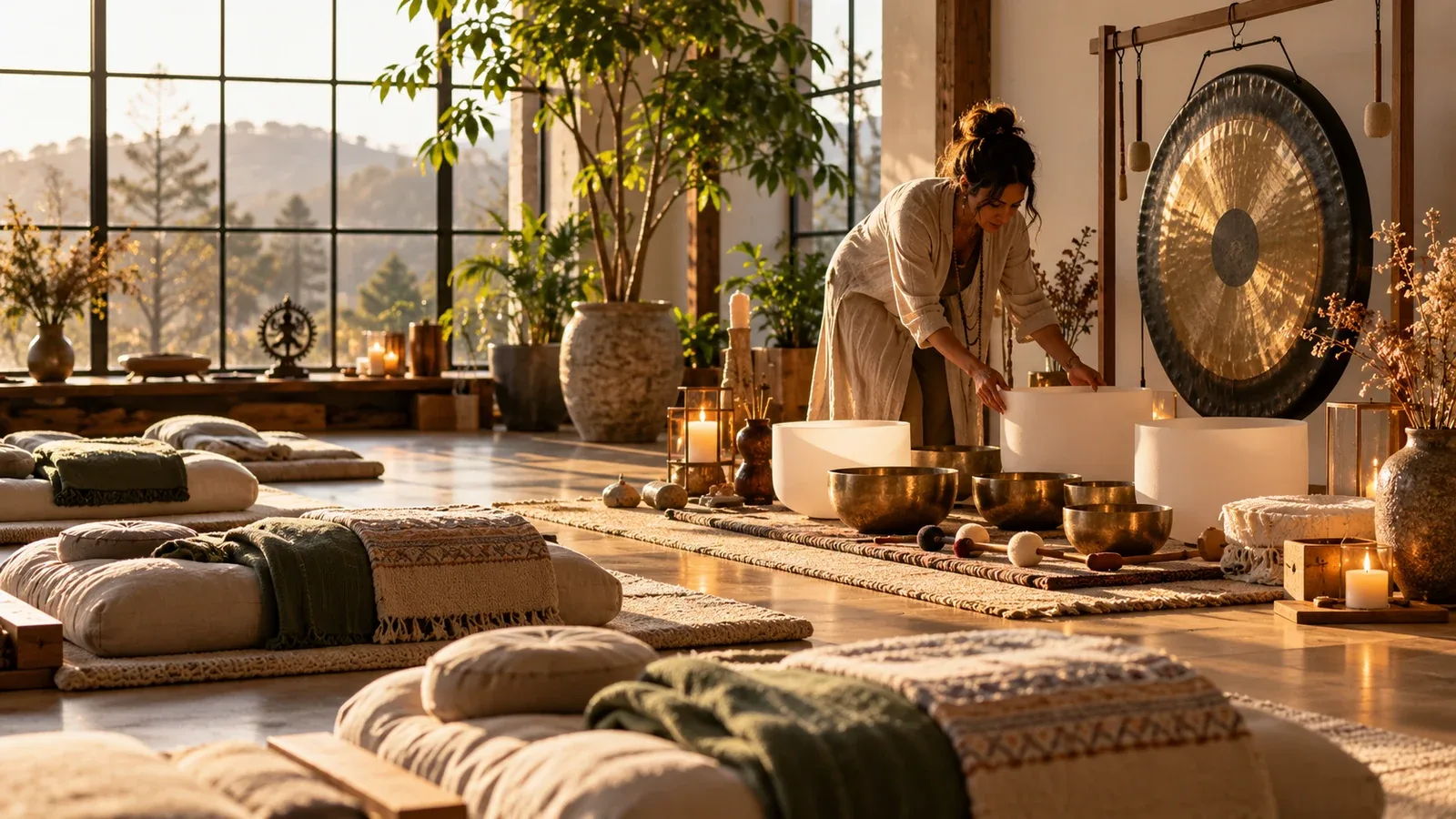
Playing beautifully is only part of holding a good sound bath. The rest is everything around the sound: whether people knew what they were signing up for, whether they could get comfortable, whether the gong was thrilling or painful, whether a nervous first-timer felt free to leave, and whether they walked out wanting to come back.
This guide is for facilitators — new and experienced — who want to get those parts right. It draws on what participants tell us, on what we see across the thousands of sound bath listings on SoundBath.co, and on the research where it exists. It isn't a training course in playing instruments; there are good ones, and nothing replaces practice.
Start before anyone arrives: the listing
Most of a participant's experience is set before they walk in. A clear listing brings the right people, reduces anxious questions, and prevents the most common disappointments.
Say exactly what happens. "An evening of sound" tells people nothing. Say how long it runs, whether it's pure sound or combined with yoga, breathwork, reiki or a ceremony, how much talking there is, and roughly how the time is spent. "75 minutes: a short guided body scan, then about an hour of crystal bowls, gongs and voice, with a few minutes of quiet to close" is exactly what a newcomer wants to read.
Name your instruments. Crystal bowls, metal bowls and gongs are different experiences, and gongs especially can be loud. People who are sensitive to sound decide based on this.
Tell people what to bring. Mats, blankets, pillows, eye masks — do you provide them or not? Is the floor carpeted or hard? Is there a chair option for people who can't lie down?
Be clear about access. Stairs, restrooms, parking, public transit, whether the space is scent-free, whether children are welcome. If you offer a sliding scale or free spots, say so plainly.
Use honest language about benefits. More on this below, but the short version: describe the experience — rest, stillness, deep listening, time to slow down — rather than promising outcomes.
Keep it current. Out-of-date dates, dead ticket links and last season's prices lose people. If your schedule changes, update your listings.
Set up the room
Space per person. People need room for a mat plus a little on either side. Crowded rooms make it hard to settle, and hard for anyone to leave discreetly. Decide your cap from the floor, not the ticket demand.
Temperature. Bodies cool when they lie still for an hour. A room that feels fine to you standing and playing will feel chilly to someone on the floor. Warm the space, and have blankets.
Light. Dim, not dark. People need to be able to find their way out. Candles are atmospheric; LED candles are safer in a room full of blankets.
Placement. Leave a clear path to the door. Think about where people sensitive to sound can set up — farther from the gongs — and say so at the start.
Outdoors. Have a plan for weather, bugs, ground damp and cold, and sound carrying to neighbors. Tell people what to bring. Outdoor sessions are wonderful and increasingly common — about 95 of the upcoming sound baths on SoundBath.co in late September 2026 were outside — but they need more logistics, not less.
Check in with people
A short intake, spoken or written, protects participants and you.
Ask, privately or generally, whether anyone is pregnant, has sound sensitivity or hearing conditions, epilepsy, an implanted medical device, a recent injury or surgery, or anything else you should know. The research on sound baths in these situations is thin, so this is caution rather than rule — but a pregnant participant lying on her side away from the gong, or a person with tinnitus given earplugs and a spot at the back, has a much better session.
Touch needs consent, every time. If you place bowls on bodies, use a tuning fork near someone, offer reiki or make adjustments, ask first. Many facilitators use a simple card or object people place by their mat to say "no touch, please" — it's easier than saying it aloud. Make "no" completely normal.
Say the important things at the start
In a minute or two, before the sound begins, tell people:
Roughly what will happen and how long it lasts.
That there's no right way to do this, and falling asleep is fine.
That they can move, adjust, sit up, open their eyes or leave at any time.
Where the restroom and exit are.
That earplugs are available (if you have them — foam earplugs are cheap and appreciated).
Whether you'll be moving around the room and playing near people, and how to let you know if they'd rather you didn't come close.
These few sentences do more for first-timers than anything you'll play.
Keep the volume safe
Gongs and large crystal bowls can get very loud, especially within a few feet. According to the National Institute on Deafness and Other Communication Disorders, long or repeated exposure to sounds at or above 85 decibels can cause hearing loss, while sounds at or below 70 decibels are unlikely to. Peaks from a gong played hard, close to someone's head, can go well past that.
Practical habits:
Measure your room. A sound level meter app (the U.S. National Institute for Occupational Safety and Health publishes a free one for iPhone) will give you a rough idea of your levels at mat height, near and far from the instruments.
Mind the distance. Keep a buffer between gongs and the nearest heads. Don't strike loud instruments right beside someone's ears.
Build gradually. Sudden loud strikes startle people out of relaxation. A swell that builds over minutes is more powerful and more comfortable.
Protect your own ears. You're exposed every session. Many working musicians wear musician's earplugs, which lower volume evenly without muffling.
Shape the session
There's no single right structure, but most sessions that people love share a few features.
An arrival. A few minutes of guided breathing, a body scan or simply quiet helps people land before the sound begins. Slow breathing, especially a long exhale, is one of the best-supported ways to help people relax.
An arc. Start simply. Let layers build. Give intensity somewhere to go and somewhere to come down from. Leave space; silence between sounds is part of the music.
Not too much talking. Guidance can be lovely, but a lot of people come to a sound bath precisely to stop listening to words. If you guide, keep it spare.
A real ending. Let the sound fade to silence and stay in it for a while. Then invite people back slowly — fingers and toes, rolling to one side, sitting up in their own time. Remind them to take a minute before standing and before driving.
Afterward. Some people want to share; many want to stay quiet. Don't make sharing mandatory. Be available for questions, and be ready for someone who was moved by the experience and needs a kind word or a glass of water.
Hold space with care
Deep relaxation brings things up. People cry, remember things, or feel unexpectedly vulnerable. A few trauma-informed habits help everyone, not just those with trauma:
Offer choice constantly. Eyes open or closed, lying down or sitting, near or far from the instruments, touch or no touch.
Avoid surprises. Tell people before you walk around the room or play something very loud.
Keep the lights low but not black, and the exit visible.
Don't interpret people's experiences for them. If someone says they felt something intense, listen. Don't tell them what it meant.
Know your limits. A sound bath is not therapy. If someone is in distress, be kind, be present, and point them toward appropriate support rather than trying to treat it.
Talk honestly about benefits
It's tempting to promise a lot. Many listings say sound baths reduce anxiety, heal trauma, detox cells, repair DNA, balance chakras or cure insomnia. Resist it.
The evidence supports a more modest story. A 2017 observational study found people reported less tension, anger, fatigue and depressed mood after a singing bowl meditation — without a control group. A 2025 systematic review of 19 clinical studies found singing bowl therapy appeared safe and potentially beneficial, while rating the randomized trials at high risk of bias. Music listening has good evidence for improving sleep quality. That's encouraging, and it's not the same as treating a condition. Our Complete Guide to Sound Baths covers the research in plain language, and you're welcome to point participants to it.
Honest language builds trust, protects you, and attracts people who'll value what you actually offer. In the U.S., the Federal Trade Commission expects health claims in advertising to be backed by evidence, so overclaiming can also create real legal exposure. Phrases that stay truthful:
"An hour to rest and listen."
"Many people find it deeply relaxing."
"A chance to slow down and let your nervous system settle." (Our piece on nervous system regulation explains what that phrase can and can't mean.)
"Not a substitute for medical or mental health care."
If you work within a spiritual tradition — chakras, energy, intention — say so as what it is: your framework and practice, rather than physiology.
Price your work
Group sound baths in the U.S. are generally affordable. Of the upcoming sound baths on SoundBath.co that listed a price in late September 2026, the median was $29, the middle half cost between $20 and $36, and about 9% were free. In Portland, one of the busiest sound bath cities on the site, the median was about $35.
When you set your price, think about the venue cost, your time including setup and breakdown, your instruments and travel, group size and what your community can afford. Sliding scales and a few free or community-priced spots widen access without undercutting you. Longer or more elaborate events — ceremonies, workshops, overnight sound sleeps — reasonably cost more.
Also consider practicalities many facilitators skip: liability insurance, clear refund and weather policies, and written agreements with host venues.
Get found
People search for sound baths by city, date and time. Make it easy for them.
List every session, not just a website. People browse by date. A calendar of specific events brings more people than a general "services" page.
Keep listings complete: instruments, length, what to bring, price, access notes, and a good photo of the actual space or setup.
List on SoundBath.co. It's free to add your events, and you can manage them yourself from your dashboard — add an event to get started. Participants find sessions by city, category, date and price, and they can follow your practitioner page. Online sessions are listed in their own Online section. Featured placements are available if you want extra visibility on your city's pages, but they're optional.
Ask for real feedback. What people tell you after a session is the best guide to what to change.
A facilitator's checklist
Before the session:
Listing is clear: length, format, instruments, what to bring, price, access
Room is warm, dim but navigable, with a clear exit path
Blankets, pillows, bolsters and earplugs are ready
Volume plan: gong placement, distance from mats
At the start:
Welcome, structure, length
No right way; sleeping is fine; move or leave anytime
Ask about pregnancy, sound sensitivity or anything relevant
Explain touch and how to decline it
During:
Build gradually; avoid sudden loud strikes near heads
Leave space and silence
Watch the room
At the end:
Slow return; time before standing
Water available; be present for anyone who needs it
Remind people to take a minute before driving
Sources
Goldsby, T.L., et al. (2017). Effects of singing bowl sound meditation on mood, tension, and well-being. Journal of Evidence-Based Complementary & Alternative Medicine.
Cai, Y., et al. (2025). Therapeutic effects of singing bowls: a systematic review of clinical studies. Integrative Medicine Research.
Jespersen, K.V., et al. (2022). Listening to music for insomnia in adults. Cochrane Database of Systematic Reviews.
National Institute on Deafness and Other Communication Disorders. Noise-induced hearing loss.
National Institute for Occupational Safety and Health. NIOSH Sound Level Meter app.
Federal Trade Commission. Health products compliance guidance.
SoundBath.co listings data, counted September 26, 2026.